Sunday, 11 September 2016

The Temple of Olympian Zeus, Athens Greece / Family Travelogue 04 June 2016

We were up early to avoid the crowd at the Acropolis of Athens.  We had walked from our hotel which is located at the Athinas Street.  We only planned to go up to Acropolis of Athens, as I thought it would take most of our day.  We managed to check out also the Temple of Olympian Zeus, Athens, it was covered anyway by the 12euros ticket we purchased for admission to twelve archaeological sites of Acropolis.  Currently, the ticket increased to 20euros.  You could check  this site for more info.


Thought of taking photos while walking.  It was very early, the shopping areas were, apparently, quiet and empty.


Church of Panagia Kapnikarea
The Church of Panagia Kapnikarea is located at Elmou Street and at the edge of the Plaka district.  It is one of the oldest churches in Athens.  It was built in the 11th century, around 1050.

Collage Cafe- Restaurant
Collage Cafe-Restaurant
Average meal  cost:  3 to 11 euros
Kapnikareas 3, 105 63, Athens Attica, Greece


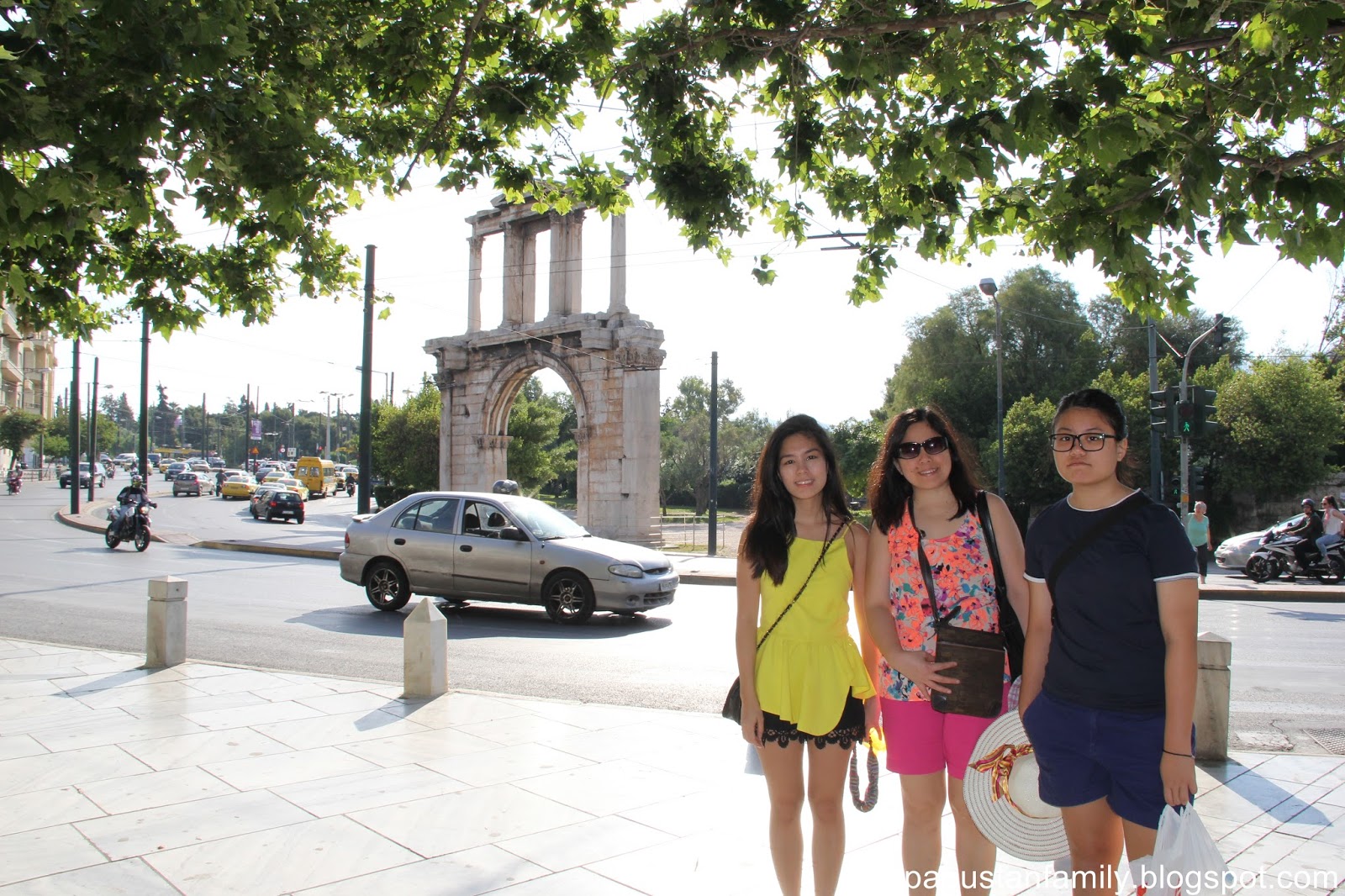
arch of Hadrian's gate from accross

Arch of Hadrian's gate from accross


Arch of Hadrian overlooking the Acropolis of Athens, Greece
Arch of Hadrian was made of Pentelic marble but of lower grade to compare with what was use for the Parthenon and other notable structures.  It is a monumental gateway or Roman triumphal arch spanned from the center of Athens to the eastern side where the Temple of Olympian Zeus was built.


The Temple of Olympian Zeus

The temple of Olympian Zeus is a Greek-Roman temple in the center of Athens.  Construction begun in the 6th century BC and completed in the 2nd century AD under the reign of Emperor Hadrian of Rome.

At present, all you could see at this archaeological site is the ruins of the temple.  It is clearly seen from the Acropolis of Athens and like the latter, it has the magnificent golden view at night. Apparently, the temple is made of the fine marble quarried from Mount Pentelus.

The temple originally have 104 Corinthian column, each 17 meters high.  48 columns stood in triple rows under the pediments and 56 in double rows at the sides.  Only 15 columns are standing at present with the corinthian capitals still in place: 13 at the south-east corner and 2 in the south-west corner.


view of the Acropolis of Athens from the Temple of Olympian Zeus, Athens, Greece

view of the Acropolis of Athens from the Temple of Olympian Zeus, Athens, Greece


view of the Acropolis of Athens from the Temple of Olympian Zeus, Athens, Greece
view of the Acropolis of Athens (farther right) from the Temple of Olympian Zeus, Athens, Greece


History of the Temple of Olympian Zeus
1.  It was initiated by Pisistratus in 515 BC but the work was held when Pisistratus son, Hippias was overthrown in 510 BC

2.  It was further left unfinished during the Greek Democary.  As per Aristotle, the temple was an example of how tyrannies focus more on the great works and left no time and energy to rebel.

3. Construction resumed during the Macedonian domination of Greece, under the Hellenistic king, Antiochos IV of Syria.  The king hired the Roman architect Cossutius to design the largest temple in the known world.  The columns and entablature of the then Corinthian order temple were erected.  But when the king died in 164 BC, the work was stopped again.

4.  Roman rule in 86 BC, General Sulla took two columns from the unfinished temple and brought to Rome beautify the Temple of Jupiter on the Capitoline Hill.  These columns influenced the Corinthian style in Rome.

5..Hadrian, a great admirer of Greek culture finally brought it to completion in the 2nd century AD, between 124 and 131.

6.  Additional buildings were completed afterwards:
   a)  a rectangular precint wall was built around the temple
   b)  Roman baths were added to the site,
   c)  Hadrian's arch, monumental arch 18m high, set at the entrance
   d)  Temple of Zeus Panhellenios was built to the south of the main temple (132 CE)
   e)  The temple of Kronos and Rhea were added in 150 CE
   f)  Buildings above were enclosed within the main complex, Valerian Wall, between 256 and 260 CE
   g)  In 450 CE, The Basilica Olympion was built along the northern side of the original precint wall.

7.  The temple suffered over the centuries and was said to have been destroyed by an earthquake during the medieval period.  The materials were re-used in other buildings.

8.  The Olympian was excavated in 1889 to 1896 by Francis Penrose of the British School in Athens.
9.  Further work had been done in 1922 by the German archaeologists, Gabriel Welter.
10. In 1960, Greek archaeologist led by Loannes Travlos continued the work.


view of the Acropolis of Athens (farther right) from the Temple of Olympian Zeus, Athens, Greece

We did not stay long at this site, not much to see but a must see.  Materials used to this temple are rare, quarried from Mount Pentelus.  See for yourself the origin of the ancient Corinthian capital. Our next stop was the famous Acropolis of Athens.  Please check out the separate post.


remaining corinthian columns of the Temple of  Olympian Zeus still in place.


Below were the photos taken after we had descended from Acropolis of Athens, Greece.  We did not visit the other archaeological sites, temperature was a bit high.  We were famished, looking forward for a great lunch in Plaka district.


Phone booth in Ahtens, Greece
Age of mobiles, uncommon to still have this phone booth.  In London, it is one of the attractions.


City bus tour, Athens, Greece

entrance to the Acropolis Museum

archaeological site below the entrance of the Acropolis Museum in Athens, Greece

lunch at Plakiotissa, Athens, Greece
Plakiotissa
located at Dion Areopagtou Plate 7
Plaka, Athens, Greece

Food was nice and the service was efficient.  I like the Pita bread.  I noticed most of the dishes are seasoned with oregano.  I now add oregano when I cook fried rice at home and to some fish dish.


I have ordered the grilled shrimp with side veggies.


My youngest did not want to try other menu.  She kept on ordering burger and fries which I kept on reminding her not healthy.


My husband always wanted to try meat, checking if it is better from the previous he had tried.


The specialty in Greece and to most in the Middle East countries, Kebab.  My eldest ordered this.

Pita bread


lunch at Plakiotissa, Athens, Greece


doves at Syntagma square, Athens, Greece


H & M at Ermou Street.  Before we went to the airport for our flight to Santorini, my eldest spent few hours walking around the high-traffic shopping area at Ermou street,  The three of us stayed at Syntagma square.


Syntagma square
Syntagma Square is the main square of Athens.
On top of the square is the used to be King's Palace.  It is now the Parliament Building.  This is where the Athenians go and complain when they do not like the law passed by the government.


Syntagma Square is a well known place, not only in Athens but in Greece.  It is an open park and well maintained.  The park is the favourite hang out of most of the locals.  If you are visiting Athens,  this is one of the must to see.


doves at Syntagma Square, Athens, Greece


At Athens airport waiting for our flight to Santorini via RyanAir.  The flight took only half an hour boarded on a small plane.  Before we took off, the steward was very busy squeezing the hand carry bags under the seats.  We arrived Santorini around midnight.


continued to Santorini Sunset Sailing, Greece
continued from Acropolis of Athens, Greece.

The separate post for Erechtheion is still under construction

Related Posts:

Athens, Greece
Acropolis of Ahtens,
Greece
Propylaea

Parthenon


Check out the places we had visited in Asia

Japan trip 2014

Hong Kong


See Also:
The making of Harry Potter

Mirabell Garden
Salzburg, Austria
Travels in France
Singapore River


Swiss Transport Museum

Chopsuey Recipe
Cycling in Singapore
Resort World Sentosa


Family World Travel

Sunday, 4 September 2016

Acropolis of Athens, Greece/ Family Travelogue 04 June 2016

The word Acropolis comes from the Greek which means the highest point or extremity.  There are many acropolis in Greece,  the Acropolis of Athens is the most well known around the world.  Acropolis of Athens is on the rocky top hill, overlooking the beautiful city of Athens.  It contains the ruins of the ancient buildings of incomparable architectural designs and of significant history such as the Parthenon (the most famous), Erechtheion, Propylaia and the Temple of Athena Nike.

Acropolis of Athen, Greece, view from the rooftop of Hotel Attalos

Acropolis of Athens, view from the Temple of Olympian Zeus

Acropolis of Athens with the view of Parthenon on the left
and the Erechtheion on the right
overlooking the beauty of the city of Athens
at the Acropolis of Athens, Greece


Acropolis of Athens, Greece with the view of Parthenon on the left and the Erechtheion on the right
steps to Propylaea, gateway to Acropolis of Athens, Greece
Propylaea, gateway to the Acropolis of Athens, Greece
The entrance to the Acropolis is the gateway called the Propylaea.  I have a separate post for this historical building.  The Propylaea is a building of the Doric order with few ionic columns supporting the roof of the central wing.  Once you reached the six massive Doric columns, you are then at the Acropolis of Athens.

Parthenon at the Acropolis of Athens, Greece


At the centre of the Acropolis is the Parthenon or Temple of Athena Parthenos.  I have also a separate post of this famous temple, Parthenon.  Parthenon is know and regarded of its extraordinary architechture.  It is made of Pentelic marbles from Mount Pentelicus or Petelikon, a mountain range in Attica, Greece.  Pentelic marble is flawless white with faint yellow tint which shines under sunlight.  Quarry of this material is protected by law and used exclusively for the restoration of the Acropolis.

Parthenon at the Acropolis of Athens, Greece


Parthenon at the Acropolis of Athens, Greece


north side of the Parthenon at the Acropolis of Athens, Greece
The North side of the Parthenon has 17 columns


Erectheion at the Acropolis of Athens, Greece

Erechtheion at the Acropolis of Athens, Greece


East of the entrance and north of the Parthenon is the temple known as the Erechtheion.  Erectheion is a classical building dedicated to Poseidon and Athena.  The caryatids sculptures are replicas.  The originals are in the Acropolis Museum.  One of  the Caryatids is in the British Museum.  I have yet started a separate post about Erechtheion.  There is so much about this building.


Erechtheion at the Acropolis of Athens, Greece


Erectheion at the Acropolis of Athens, Greece


South of the platform that forms the top of the Acropolis there are also the remains of an outdoor theatre called Theatre of Dionysus.

Odeon of Herodes Atticus


Not so far away, a partially restored Odeon of Herodes Atticus.


view from Acropolis:  unfinished Odeon of Herodes Atticus and on the left side,  Philpappos Monument on top of Mouseion Hill (known also as Philopappos Hill)
Philopappos Monument on top of Mouseion Hill (known also as Philopappos Hill), view from Acropolis of Athens, Greece
Philopappos Monument was erected on Mouseion Hill, southwest of the Acropolis of Athens, by the citizen of Athens in memory of Philopappos who died in 116.  The built of the marbele tomb was initiated by Philpappos then grieving sister, Julia Balbilla.  Mouseion Hill is presently known as Philopappos Hill.

It has been a tradition for locals to fly kite on clean Monday every year.  It is suppose to help you wash away your sins.  The higher the kite goes, the more sins are washed away.
People fly kites at Hill of Philippapos on clean Monday.

Ruins of Temple of Rome and Augustus, few meters away from Parthenon
One of the monuments left almost nothing is the temple dedicated to the first emperor of the Roman Empire, Augustus.  It was a small and circular building located few meters from the Parthenon called the The Temple of Roma and Augustus.  This temple was constructed coincides with the second visit of the emperor to soften his anger due to past Athenian opposition to Rome or personally to Augustus evident by Athenian support of Anthony.

Given a time, I would love to watch the historical movies in regard to Greece and Egypt seeing these buildings, temples and monuments standing.  Wandering in the Acropolis of Athens could tell you how marvelous the place was.  It was in the 17th century an Ottoman ammunition was dump inside the Parthenon damaging severely the temple and its extraordinary sculptures.

In the early years of 19th century, British Earl of Elgin took most of the sculptures in the Acropolis of Athens, most especially in the Parthenon, allegedly with Ottoman empire;s permission and sold to the British Museum in London.  To date, the said original sculptures are displayed in London.  It's like seeing Acropolis of Athens not in Athens.There is now an on going petition for the British to return these controversial Elgin marbles/sculptures to where they belong, which is in Athens, Greece.

Temple of Olympian Zeus and the Hadrian gate, view from Acropolis of Athens, Greece
I have more photos to share of the ruins of Temple of Olympian Zeus on a separate post.

Acropolis Museum, view from Acropolis of Athens, Greece

Acropolis museum was built to house every artifact found at the Acropolis of Athens.  It was opened in 20 June 2009.  Aside from the original marbles displayed in the museum, they put also the replicas of the Elgin Marbles, purposely in different colour, to show that they are replicas.  More so, said is to show the British that Greece has provided a place for the marbles should they be returned.  As mentioned earlier, the originals were taken by Lord Elgin to Britain and sold to British Museum.


Greek flag on the northeast corner of Acropolis of Athens

There was an elevated spot on the northeast corner of the Acropolis of Athens with a Greece flag standing. From up there, you could see the panoramic view of the city of Athens

During the German invasion in 1941, the Germans ascended to the Acropolis of Athens and ordered the young Evzone (greek army), Konstantinos Koukidis, to take down the greek flag and replace with the swastika flag.  The young soldier calmly did it but did not hand over to the Germans.  He wrapped instead himself in it and fell off the Acropolis to his death.

There is a plaque by the flag dedicated to Manolis Glezos and Apostolos Santas.  They bravely took down the Swastika flag stood at the Acropolis of Athens.  The Nazis sentenced them to death in absentia (their identities were unknown until much later).  Their acts inspired the Greeks to resist against the occupation.


Ancient Agora and the view of Hephaestus temple from Acropolis of Athens, Greece

Areopagus hill (known also as Mars Hill)
Areopagus is a bare marble hill, steps can be slippery.  It is located across the entrance to the Acropolis.  In the earlier years, the hill functioned as the chief Homicide court of Athens.

According to Greek mythology, Ares (god of war, known to the Romans as Mars) was tried here by the gods for the murder of Poseidon's son Alirrothios.  Another legend, Orestes was tried on this site for killing his stepmother and her lover, Clytemnestra and Aegisthus.

Beule gate to the steps to Propylaea;  further right, the Areopagus hill
Temple of Hephaestus in Athens, Greece
The Temple of Hephaestus (know also as Theseion in the much earlier years) is a well preserved Greek temple and remains standing as per history it has been used for varied purposes.   It is a Doric design and is located at the north-west side of the Agora of Athens, on top of the Agoraios Kolonos hill.  From the 7th century until 1834, it served as the Greek Orthodox church of Saint George Akamates.  It was believed to have been constructed from 449 BCE to 415 BCE.

Hephaestus was the patron god of metal working, craftsmanship and fire.

view of Mount Lycabetoos and the Kolonaki neighborhood
Mount Lycabettus is a limestone hill in Athens, Greece at 300 meters above sea level.  It can be ascended by a funicular.

As per Greek Mythology, Athena created Mount Lycabettus when she dropped a limestone mountain she had been carrying from the Pallene Peniusula for the construction of Acropolis after the box holding Erichthonius was opened.

night view of the Parthenon on Acropolis of Athens, Greece
Parthenon is made of Pentelic marbles.  Pentelic marbles are flawless white with yellow tint, which makes it shine under the sunlight and marvelous golden view at night.

night view of the Parthenon on Acropolis of Athens, Greece


to continue on The Temple Olympian of Zeus/ last day in Athens
continued from Parthenon


Related posts under construction

Temple of Zeus

Erectheion

Related Posts:

Athens, Greece
Chanel sunglasses
unboxing
Propylaea

Parthenon


Check out the places we had visited in Asia

Japan trip 2014

Hong Kong


See Also:
The making of Harry Potter

Universal Studios
Singapore
Travels in France
Singapore River


Swiss Transport Museum

Chopsuey Recipe
Cycling in Singapore
Resort World Sentosa


Family World Travel